The hidden inequality of urban shade


Shade is a critical resource.
But is it equally accessible across cities?
We find consistent spatial and socioeconomic disparities across 9 cities globally.
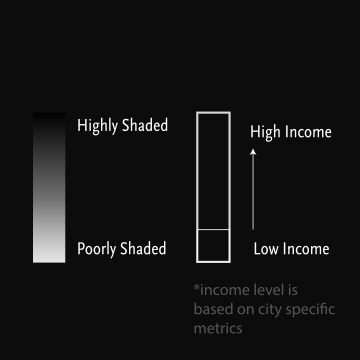
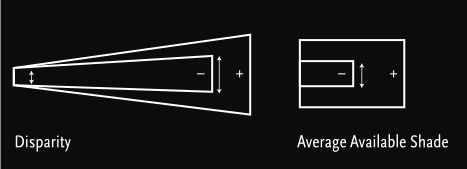
The disparity of shade across major cities shows the prevalence of thermal comfort privileges.
Shade provision is the most effective strategy for reducing heat in cities; yet its distribution remains highly uneven. Our study investigates shade casting from buildings and trees on pedestrian areas, combined with socioeconomic data at the neighborhood level. We assess shade availability across nine climatically and geographically diverse cities: Amsterdam, Barcelona, Belém, Boston, Hong Kong, Milan, Rio de Janeiro, Stockholm, and Sydney. Our results reveal a consistent pattern of spatial and socioeconomic inequality: lower-income and peripheral neighborhoods tend to receive significantly less shade, while wealthier areas benefit from disproportionate abundance. By focusing on public pedestrian spaces this study highlights the importance of measuring heat burden through the lens of human experience, rather than general coverage.
Gu, X., Beuster, L., Liu, Xi., van Leeuwen, E., Venverloo, T., Duarte F. (2026). Global patterns of inequality in pedestrian shade provision, Nature Communications.
The material on this website can be used freely in any publication provided that:
For more information,
senseable-contacts@mit.edu